Quality IT, Advice, Support and Delivery

Showing posts with label Practical Networks. Show all posts

Thursday, 17 March 2016

SQL Server 2005 End Of Life

Last year we saw Microsoft retire Windows Server 2003 and this year will see Microsoft retire yet another product. SQL Server 2005 is the latest Microsoft product nearing its end of life date of April 12, 2016.


What does End of Life mean for end users?
Every product we use is likely to have a lifecycle, and Microsoft products are no different. All that Microsoft mean by the end of life of any of their products, SQL Server 2005 included, is that Microsoft will no longer support the product. Ultimately this means that Microsoft will no longer provide automatic fixes, updates or online technical support for retired products.

After April 12, 2016 SQL Server 2005 will no longer receive assisted technical support from Microsoft, software and content updates or the security patches that help provide protection from harmful viruses, spyware and other malicious software, thus resulting in an insecure and unstable infrastructure for your business. Not migrating away from SQL Server 2005 will expose you to an elevated risk of cybersecurity dangers or malicious attacks.

What are the options?
Literally speaking you have two options, you can upgrade to a newer version of SQL Server or you can continue to use an unsupported SQL Server 2005. However it is highly advisable that you do upgrade, not only for security reasons, but also because continuing to use an outdated system can cause compliance issues and end up costing a small fortune in maintenance costs.

Why upgrade?
Continuing to use out of date software poses potential security risks and is likely to make you a prime target for hackers, as it is easier for cyber criminals to exploit vulnerable software. After April 12, 2016 it is highly likely that you will need to invest in extra security to protect the vulnerable SQL Server 2005, and the cost for maintaining aging hardware will continue to increase with time. Another key reason to upgrade is compliance, many compliances require up-to-date, patch databases, just like they do with the operating system.

Additionally software has progressed since the release of SQL Server 2005 and so there are significant improvements and features that have been added to newer versions of SQL Server. For example SQL Server 2014 provides higher availability and scalability, with dramatic performance improvement, compared with the soon to be outdated SQL Server 2005. The benefits of upgrading to a modern data platform far outweigh the costs of maintaining security, support and compliance for an unsupported database.

Act Now – Upgrade
Upgrading is an opportunity to provide new value to your business, by enabling you to achieve breakthrough performance.

Here are the three key steps for upgrading away from SQL Server 2005:  discover, target and upgrade. 

Step 1 – Discover:
It is highly recommended that you start by determining which applications are running SQL Server 2005. This process can be done using the Microsoft Assessment and Planning Toolkit or by collaborate with Practical Networks, a Microsoft Partner, who will be able to assist with the whole
upgrade.

Step 2 – Target:
In this step you need to determine a migration destination for each application, whether on-premises, virtualized or in the cloud. The choice of destination will be driven by factors such as speed, ease of migration, cost and desired functionality, with the most common choice being Windows Server 2012 R2.

Step 3 – Upgrade:
The final step is to plan and execute the upgrade, this may require additional assistance. Such assistance is available from Practical Networks a trusted Microsoft Partner.

If you would like more information or any assistance with your upgrade, please do not hesitate to get in touch with either David Philps or Andy Potts on 01723 587240.

Thursday, 29 October 2015

Veeam Availability Suite & Veeam Backup Essentials

What is Veeam Availability Suite?
Veeam Availability Suite provides availability for all applications, by combining the industry leading backup, restore and replication capabilities of Veeam Backup and Replication with the advanced monitoring, reporting and capacity planning functionality of Veeam ONE. Veeam Availability Suite delivers everything you need to reliably protect and manage your VMware vSphere and Microsoft Hyper-V environments.

Veeam Availability Suite Version 9:
Veeam have announced that version 9 of Veeam Availability Suite is to be released soon, offering a number of new features, such as:
·   Veeam Integration with EMC snapshots
·         Fast and secure cloud-based disaster recovery
·         Fast and low impact backups with EMC, NetApp, HP and more.
·         Enterprise-level enhancements for Veeam Explorers
·         Availability for the enterprise
·         Veeam integration with HP StoreOne Catalyst and other backup storage integration
·         Unlimited scale-out backup recovery


Veeam Backup Essentials

What is Veeam Backup Essentials?
Veeam Backup Essentials provides small businesses with a reliable, effortless and affordable enterprise-class backup solution, designed to help businesses remain always-on. Veeam Backup Essentials offers the same functionality as Veeam Availability Suite, but is priced for small businesses.

Veeam Backup Essentials Key Features include:
·       High-speed recovery
·         Data loss avoidance
·         Verified Protection
·         Leveraged Data
·         Complete Visibility


       For more information please contact Practical Networks a Veeam Partner on 01723 587240 or email info@practicalnetworks.co.uk


Thursday, 17 September 2015

VMware Horizon 6 and how it can benefit you..

What is Horizon 6?

VMware Horizon 6 leverages the best of Horizon View and extends these benefits beyond VDI, providing end users with on place to securely access all their desktops, applications and online services, from any device. Horizon 6 allows organisations to deliver virtualised or remote desktops and applications through a single virtual desktop infrastructure (VDI) platform and support end users with access to all their desktops and applications through a single unified workspace.

With Horizon 6, VMware have introduced six new key capabilities to help organisations deliver unlimited access to desktops and applications, at lower costs and with better performance. These enhancements help maximize operational efficiency and consolidate control.

The Key Features are:

Applications:
  • Supports end users with robust access to SaaS apps, Web apps, packaged VMware ThinApp apps, RDSG-Hosted apps and Citrix XenApps, through a single unified workspace.
  • Enhanced support for USB drives with RDSH-hosted apps and session-bases desktops for file storage, sharing and collaboration.
  • Support for scanning and imaging devices with virtual desktops and RDSH-hosted applications.
  • Client drive redirection to ensure simple drive mapping to a virtual desktop.
  • Google Chrome client support.
  • Client-free, HTML access to legacy Windows apps across more devices, including Google Chromebooks.
Virtual Networking:
  • VMware NSX with Horizon 6 brings push-button simplicity to VDI Networking. IT administrators can create and change policies for end users within seconds.
  • Policies dynamically follow the end user across devices and locations, without the need for time-consuming network provisioning or security rules. 
  • Organisations can easily scale up or down, and each end user's network security policy will remain intact.
  • Horizon 6 provides a highly extensible platform that integrates with industry leaders in antivirus, malware, intrusion prevention services and next-generation security policies, by extending security policies from the data center to the device.
Graphics:
  • Immersive 3D graphics delivered from the cloud.
  • VMware provides full support for the industry's leading ISV applications, including Siemens, ESRI and Autodesk.
Storage:
  • Horizon 6 leverages optimised VMware Virtual SAN 6.0, ensuring that customers can easily scale out and support up to 4,000 Horizon 6 virtual desktops per cluster.
  • Support for all-flash Virtual SAN ensures end users can enjoy great experience with the best possible TCO.
  • Horizon 6 now supports Virtual Volumes VM-aware storage systems to simplify storage management and policy settings for VDI.
Scalable and Available:
  • Horizon 6 allows organisations to design virtual desktops around a wide range of validated technology partners or leverage hyper-converged infrastructure with VMware EVO:RAIL, to linearly scale out desktops and apps on demand.
  • Applications can be delivered in real time with VMware App Volumes, now integrated with Horizon 6.
  • Organisations can ensure that end users enjoy high availability with continuous access to services, by leveraging the Cloud Pod Architecture available with Horizon 6.

Fed-Ready:
  • Horizon 6 is designed and certified to meet the most demanding compliance regulations, including those of the U.S. Federal Government.
  • Horizon 6 now provides Common Access Card support for simple and secure access to apps and desktops for agencies that require it.
  • Horizon 6 also provides end-to-end support for IPv6 networks for simplified packet processing and address assignments.
Horizon 6 offers improved security, simplified operations and accelerated time-to-value, and is available in three editions, Standard, Advanced and Enterprise. For more information about VMware Horizon 6 or other VMware products please contact Practical Networks, a VMware Partner on 01723 587240.


Thursday, 3 September 2015

What is Desktop Virtualisation?

What is Desktop Virtualisation?

Desktop Virtualisation is a virtualisation technology used to separate a computer desktop environment from the physical computer. Similarly to Server Virtualisation, Desktop Virtualisation relies on a thin layer of software known as a hypervisor, which is run on bare-metal server hardware and provides a platform on which administrators can deploy and manage virtual machines.

Virtualised desktops are stored on centralised or remote servers and not on the physical machine being virtualised. The virtual desktop environments are "server" to users on the network, allowing them to remotely log in to access their desktop from any location.

Why Virtualise your Desktops?

Desktop Virtualisation offers numerous benefits to businesses, including; reducing costs, increasing efficiency, enabling flexible working and centralising management of user desktops.

Desktop Virtualisation offers numerous features to organisations of all shapes and sizes, ultimately resulting in a range of benefits. For more information about Desktop Virtualisation contact Practical Networks, a VMware partner on 01723 587240.


Thursday, 11 June 2015

What are Unified Communications?

What are Unified Communications?


Unified communications (UC) is the term used to describe communications which integrate to optimize business processes and increase user productivity. UC’s optimize business processes and increase user productivity by eliminating device and media dependencies and managing flows. UC systems typically include the means to integrate real-time or near-real time unified messaging, collaboration and interactive systems; however such integration takes on numerous forms. 

Unified communications are not a single product, but a collection of components, including but not limited to the following:

• Call control & Multi-modal communications
• Presence information
• Instant messaging
• Unified messaging
• Speech access & Personal assistant
• Conferencing (audio, web & video)
• Collaboration tools
• Mobility
• Business process integration

Unified communications are purpose built to grow and change with the pace of your business, providing numerous benefits along the way. These benefits include:


We are now suppliers of both Cisco and Panasonic systems, which provide benefits such as; reducing costs, increasing productivity, diversifying the workplace and allowing for quick and effective call response.  For more information about UC’s call Practical Networks on 01723 587240.

Thursday, 28 May 2015

Windows Server 2003 Migration Planning

Windows Server 2003 end of life is the perfect excuse for business innovation, so why not take advantage of the opportunity. Migrating away from Windows Server 2003 allows you to update your system and take full advantage of the updated features available with newer software. The migration solutions available offer new data center automation and a flexible infrastructure that breaks through the traditional boundaries of storage, virtualisation and identity, while providing an application platform to support the growing demands of today’s businesses.

As you may have read in our Windows Server 2003 End of Life post, there are a number of other reasons why it is ideal for businesses to migrate before the end of life date of July 14, 2015. Migration is a lengthy process and will take a lot of planning and preparation; however it is worth the time and effort. Migrating will help you achieve concrete benefits such as; improved performance, reduced maintenance requirements and increased agility and speed of response. 

Migrating – Where to start:
As a Microsoft Partner we recommend using the following four stages to plan your migration:     
      Ã¼  Discover
      Ã¼  Assess
      Ã¼  Target
      Ã¼  Migrate
A document detailing these stages in full can be found here >> http://bit.ly/1zk7Rgx

Stage 1 – Discover

In order to plan what application need to be upgraded or migrated you need to establish what applications and workloads you have running on Windows Server 2003. When making a note of all of your applications it is also important to make a note of the versions, licensing agreements and what hardware they run on. 

Stage 2 – Assess
Now you need to categorise and analyse all of your listed workloads and applications based on type, criticality, complexity and risk.  This can help you to evaluate whether to re-host, refactor, revise, rebuild or replace applications and also help you to prioritise workloads and applications for migration by identifying issues or opportunities such as:
      Ã»  Vital business-critical applications and workloads that need immediate attention and additional                                    capacity
      Ã»  Redundancies in your environment and mismatched service levels
      Ã»  Applications without the right level of IT control
      Ã»  Misallocated resources for underutilised or unneeded business-critical projects


Stage 3 – Target

This is the phase where you need to determine the migration target destination for each application and workload. In this phase you have the opportunity to transform your business by embracing newer, more efficient and cost effective ways of delivering IT solutions to your users. Different workloads and applications will logically lead to certain targets, while others may offer the possibility of migration to multiple target destinations. The choice will ultimately be driven by factors such as; speed, ease of migration, cost and desired functionality.

 Stage 4 – Migrate
The migration itself will require smart planning and focused execution, in order to make sure goals are met. Choosing the right migration plan for your organisation may require additional analysis and assistance.

As a Microsoft Partner, Practical Networks are readily on hand to provide any guidance or assistance that you need with your migration. For help starting your migration plan call Andy on 01723 587240 or email migrate@practicalnetworks.co.uk


Wednesday, 13 May 2015

Windows Server 2012 R2 - Upgrade Now!


As cybersecurity is set to be a major focus for businesses this year, we feel it fitting that our software pick this quarter is the Windows Server 2012 R2. Windows Server 2012 R2 is the most recent version of Microsoft’s Windows Server Platform and so is the most logical choice when migrating from Windows Server 2003, which retires in June.


What is Windows Server 2012 R2?
Windows Server 2012 is an enterprise-grade, open application and web platform that forms a foundation for businesses, by helping build, deploy, and scale modern applications and high-density websites for the datacentre and the cloud. Windows Server 2012 R2 also enables IT to empower users by providing them with flexible, policy-based resources while protecting corporate information.


The Benefits:
• Simplified deployment of IT services

• High service uptime

• Secures corporate data

• Easily scales to continuously run the largest workloads

• User Centric

• Application focused

• Simple & Cost effective

• Disaster recovery & Business continuity

Disaster Recovery & Business Continuity:
Windows Server 2012 allows you to achieve affordable, multi-node business continuity scenarios with high service uptime and at-scale disaster recovery. Windows Server 2012 has powerful availability features to protect against service outages, along with automated protection and recovery for cost-effective business continuity. These features allow for improved workload SLA’s and a reduced downtime risk.

User Centric:
Business technology has become increasingly mobile and user centric and with Windows Server 2012 end users will have access to information and data regardless of the infrastructure, network, device or application. Windows Server 2012 also makes it possible for you to provide consistent access to corporate resources by managing and federating user identities and credentials across the organisation, while providing secure access to your corporate network. Additionally Windows Server 2012 helps you better protect information and manage risk, by validating user identities, verifying their devices and taking advantage of data classification.


So if you’re looking to migrate away from Windows Server 2003 or just want to update your system, look no further. For more information or for assistance in migrating call Andy on 01723 587240.

Thursday, 30 April 2015

Cybersecurity & Mobile Security Tip for Businesses!

Cybersecurity is becoming more and more of an issue for businesses, as security attacks are evolving at an alarming rate. Last year in particular saw a number of high profile security breaches, such as; Heartbleed and Shellshock, positioning cybersecurity as a major concern for businesses and individuals alike. So here are 10 tips on how to protect your business against cyber-attacks:

1.       Establish basic security practices and educate all of your employees in these practices. This will help ensure all of your employees understand how to handle and protect vital business and customer information.

2.       Make sure all computers and networks are protected, by making sure that anti-virus, anti-spyware and firewall software is installed and kept up to date on all corporate PCs. It is also in good practice to schedule regular anti-virus scans on all PCs.

3.       Protect your internet connection with firewall security and make sure that firewalls are maintained. It is also important to make sure that employees who work from home have a secure internet connection.

4.       It is vital to keep your operating system and all your software up to date, by installing the latest updates and security patches. Updates can be set to install automatically, saving time and ensuring they are installed as soon as they are available. (Cyber criminals will take advantage of vulnerabilities found in out of date or unpatched software)

5.       Employ some form of disaster recovery and backup strategy, to regularly backup all of your data. In the case that your computer does become infected, you will be able to restore all your files once the malware has been deleted.

6.       Don’t allow unauthorised individuals to use business computers and secure your Wi-Fi network with passwords (preferably not the password that the device came with).

7.       Ensure all employees use a strong password, one that uses a mix of numbers, upper and lower case letters and symbols. Also make sure passwords are changed regularly.

8.       Limit employee’s access and authority according to their roles. Only provide access to the specific data systems that are needed to carry out their roles.

9.       Make sure all employees know to avoid opening emails or email attachments from unknown sources or that don’t appear to be legit. It is often the case that email attachments carry malware so be cautious and one infected PC could put the whole network at risk.

10.   Enforce strict rules about installing new software and only install software from trusted sites. 


       The number of businesses allowing for BYOD is increasing, and so it is important for them to keep their data secure on all devices. Malware is not just a problem for PC’s, as cybercriminals have taken to hiding their malicious codes inside mobile apps. So we have some Security Tips to protect your Mobile Workforce.

7 Tips for a Secure Mobile Network:

1.       Don’t let mobile security be your blind spot; mobile devices need the same protection as your corporate PC’s, so implement security precautions on all mobile devices.

2.       Add security measures to your wireless network - a password or security key can keep unauthorised devices from accessing your wireless connection. Encryption technology can also help, by protecting the information transmitted through your network.

3.       Encourage employees who use mobile devices for business purposes, to password protect their devices and set them to lock within five minutes. Passwords act as a first line of defence should the device fall into the wrong hands.

4.       Educate your users about carefully examining app permissions before granting access. Most apps ask for access to many unnecessary features on your device.

5.       Develop a policy item to determine which apps can be downloaded or accessed via the corporate network. If an app has a weakness it is easier to hack, posing a threat to your corporate security.

6.       Lose it, Lock it, Wipe it - download an app on your mobile devices that allows you and your employees to lock and wipe the device in the event of theft or loss. Should your device be gone for good such apps will enable you to wipe all of your data including text messages, contacts, photos, email, browser history and user accounts.

7.      Update apps as soon as you are prompted to, as updates can include fixes to new vulnerabilities and exploited security gaps.

For any more information on how to keep your corporate date secure, contact one of the team on 01723 587240


Thursday, 16 April 2015

Mobile Security - A Business Must Have!

Mobile security is becoming increasingly more important for businesses; due to the significant increase in bring your own device (BYOD) workforces. Companies put a lot of effort into building up their network defences for PCs, however most seem to overlook smartphone security, but there are now a great deal more mobile devices than PCs.


The BYOD policy has completely changed the way in which organisations need to approach their network security. Mobile devices have the ability of working inside and outside of the corporate network and can automatically connect to the corporate system, accessing sensitive data and then connect to other networks outside of the organisation. This is all done while bypassing the intense security measures built for PCs, potentially exposing your company data. 


Symantec’s 2013 Norton Report showed that nearly half of smartphone and tablet users don’t use basic precautions such as passwords and security software and that 57% were unaware that security solutions are available for mobile devices. Also according to a study from BT, 41% of UK organisations were hit by mobile security breaches. These are worrying statistics for organisations which allow for BYOD, and so it is important to make sure everyone in your organisation is aware of the importance of mobile security.


Loss and theft both pose a big threat to mobile security, as mobile devices are more vulnerable to loss and theft than PCs. Once lost or stolen any corporate data is at risk without proper security in place, such as passwords, encryption, multi-factor authentication app or apps that allow you to remotely wipe your device in the event that it is lost or stolen. 

Applications also pose one of the biggest threats to mobile security as the number of organisations building their own apps to fit their business needs is growing, with 48 % of businesses expecting to increase their mobile app budgets. Purpose built apps are useful for businesses, however they are also the weakest point of entry for cyber-criminals. Applications have to ask for access to many features on your device, however very few users examine these permissions, making it easier for malicious app developers to gain unnecessary permissions.

While applications, loss and theft pose some of the biggest threats to mobile security there are other threats that you need to protect yourself from. Lookout have suggested that mobile security threats usually fall into one of the following four key categories; application-based, web-based, network-based and physical. Each of these categories can be broken down into further threats, details of which can be found here.

Keep watching our blog for tips on how to keep your business protected from mobile and cybersecurity threats.


Thursday, 2 April 2015

Cybersecurity set to be big issue for Businesses...

Last year saw a number of highly evolved cyber-attacks and data breaches across the globe, with server vulnerabilities such as Heartbleed and Shellshock taking center stage. As a result of the number of high profile security breaches and cyber-attacks, Cybersecurity has been positioned as a key priority for organisations in 2015.

Cyber-security attacks are evolving at an alarming rate, and so the cyber-security products available to businesses are rapidly evolving to keep ahead of cyber criminals.  Therefore it is more important than ever for businesses to keep up to date with the latest versions and updates of their firewalls, antivirus software, intrusion detection/protection systems, VPNs or any other security they may have in place. On top of this it is a good idea for businesses to reassess their cybersecurity practices periodically to ensure they have the best protection available to them.

Cyber security threats come in a wide range of shapes and sizes, such as; malware injection, phishing, social engineering, internal stealing of data among others. However ransomware has been one of the most common forms of malware used over the past few years, and Symantec’s 2014 Internet Security Threat Report noted that ransomware attacks grew by 500 percent in the latter part of 2013. Scammers also continued to run profitable ransomware scams last year, with Cryptolocker making up 55 percent of all ransomware in October 2014 alone.

With the wide range of security products available for businesses, such as; anti-viruses, firewalls, encryption software, intrusion detection/protection systems, it is easy to overlook the need for secure passwords. Passwords still provide the first level of defence against hackers and so it is still important to make your passwords as secure as possible. So why not make sure your password isn’t on SplashData’s worst passwords of 2014 list:
  1. 123456
  2. password
  3. 12345
  4. 12345678
  5. qwerty
  6. 123456789
  7. 1234
  8. baseball
  9. dragon
  10. football
The full list can be found here… “Worst Passwords of 2014”


Tuesday, 17 March 2015

Step by step guide to set up email on your iPhone

Email set up is often the first step in setting up a new phone; however it is also one of the most common problems on our helpdesk. So here is a step by step guide to setting up your work email on an iPhone...

Firstly launch the settings app by selecting the settings icon on your home screen. (It usually looks something like the image below)

After selecting the settings icon, you need to select Mail, Contacts, Calendars from the list. Then you will need to select Add Account followed by Microsoft Exchange.


On the next screen you will need to enter the following information:
  1. Email – enter your entire email address, using all lowercase letters
  2. Domain – leave this field empty
  3. Username – enter your entire email address again
  4. Password – enter the password for your email account
  5. Description – enter a descriptive name for your account (eg. Work)

Once complete tap the next button and your device will attempt to verify your account.


If you receive an “Unable to Verify Certificate” message tap the accept button, the device will then continue verifying the account. Once complete tap the Server field, and enter in connect.emailsrvr.com


Tap the next button and the device will then try to create a secure (SSL) connection to your Exchange server. When connected, you will see check marks along your settings to confirm that the account has been verified.


Finally tap the ON/OFF buttons to select which information to synchronize with the Exchange server and then tap Save to finish.

For more step by step guides like this follow us on LinkedIn 

Thursday, 5 March 2015

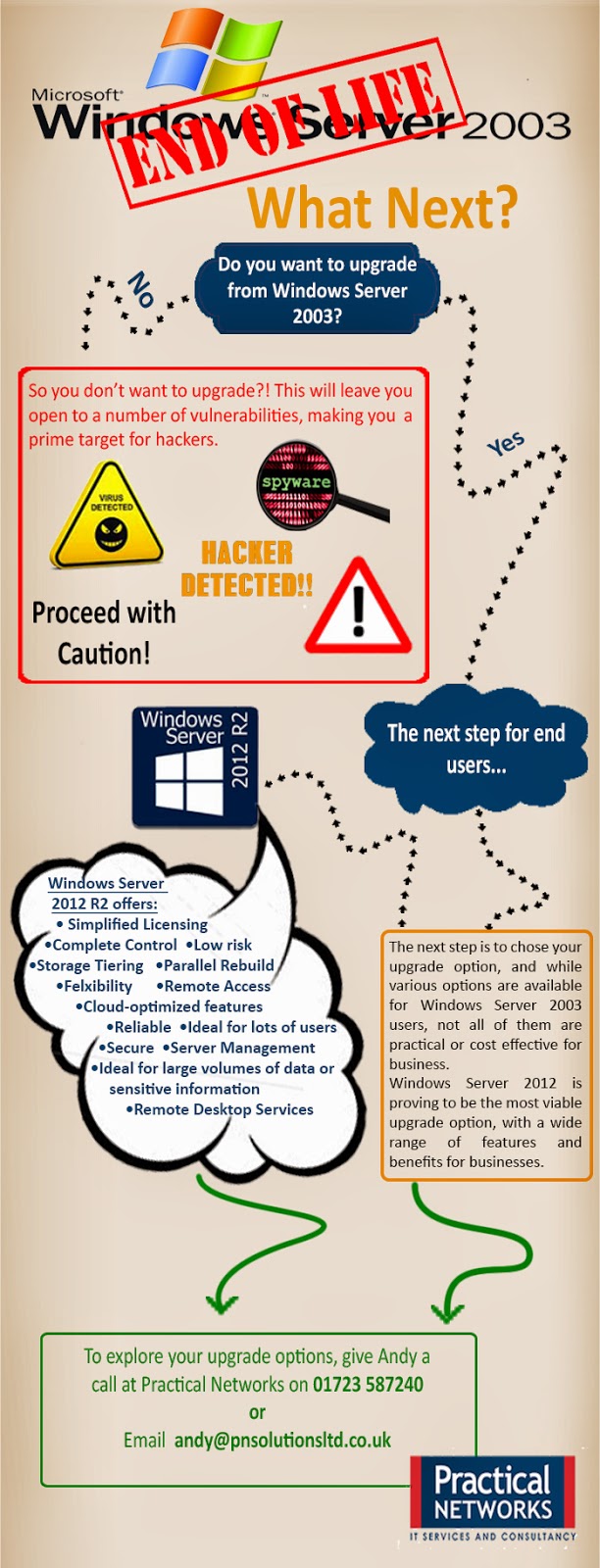
Windows Server 2003 End of Life - Be Prepared!

Last year we saw Microsoft retire both Windows XP and Office 2003 and this year will see Microsoft retire yet another product. Windows Server 2003 is the latest Microsoft product nearing its end of life date of July 14, 2015.

What does End of Life mean for end users?
Every product we use is likely to have a lifecycle, and Microsoft products are no different. All that Microsoft mean by the end of life of any of their products, Windows Server 2003 included, is that Microsoft will no longer support the product. Ultimately this means that Microsoft will no longer provide automatic fixes, updates or online technical support for retired products. 

After July 14, 2015 Windows Server 2003 will no longer receive assisted technical support from Microsoft, software and content updates or the security patches that help provide protection from harmful viruses, spyware and other malicious software, thus resulting  in an unsecured and unstable infrastructure for your business. Not migrating away from Windows Server 2003 will expose you to an elevated risk of cybersecurity dangers or malicious attacks.  


Continuing to use an unsupported server operating system would not only leave you vulnerable to hackers and security attacks, but it could end up costing your business a small fortune in maintenance costs. After July 14, 2015 you will need intrusion detection systems, advanced firewalls and network segmentation  to protect the vulnerable Windows Server 2003 platform, and the cost for maintaining ageing hardware will continue increasing with time. Also you may find that using an unsupported server operating system will result in a failure to meet industry wide compliance standards, which could ultimately result in a loss of business.

Another reason to migrate away from Windows Server 2003 before the end of life date is the fact that new software and hardware devices will no longer be built to integrate with Windows Server 2003, thus resulting in compatibility issues when updating software or hardware.

Act Now – Discover your upgrade options
As we explored above it is highly unadvisable to continue using Windows Server 2003 after it reaches its end of life, and so the only remaining option is to upgrade.  It is important to start your upgrade early as it will take a lot of planning and executing, and leaving it until the last minute is a big risk to take.

Here are the four key steps for migrating away from Windows Server 2003 as; discover, access, target and migrate.  


 Step 1 – Discover:
It is highly recommended that you start by finding out and cataloging the applications and workloads you have running on Windows Server 2003. It is vital that you catolog everything that you have running on Windows Server 2003, as this will help insure that nothing is omitted from the migration.

Whether you use the Microsoft self-service toolkit or collaborate with a Microsoft Partner this process is a lengthy yet essential part of the migration planning.

Step 2 – Assess:
Once you have a complete catalog of applications and workloads, it is time to assess its contents. This means categorising and analysing your applications and workloads based on four key factors, type, importance, complexity and risk. This assessment will allow you to prioritise workloads and applications for migration, while also helping identify and issues.

Step 3 – Target:
In this step you need to determine a migration destination for each application and workload. The choice of destination will be driven by factors such as speed, ease of migration, cost and desired functionality, with the most common choice being Windows Server 2012 R2.

Step 4 – Migrate:
The final step is to execute the migration, however finding the right migration plan may require additional analysis and assistance. Such assistance is available from Practical Networks a trusted Microsoft Partner.

If you would like more information or any assistance with your migration, please do not hesitate to get in touch with either David Philps or Andy Potts on 01723 587240.

Thursday, 19 February 2015

BYOD enable your business with VMware Horizon View

In our current device centric environment, end users expect to be able to stay connected to their professional networks via mobile devices and that’s where this quarter’s software pick comes in. This quarter we have chosen to introduce you to VMware Horizon View, a software that provides an agile and adaptive approach to computing, enabling IT to balance business requirements with the needs of end users.

What is Horizon View?

Horizon View is complete solution for desktop and application virtualisation, brought to us by VMware.  Horizon View offers organisations the flexibility to meet the needs of a mobile and global workforce, all while maintain extremely high levels of security and control. This is done by placing all of your organisation’s desktops into one centralised managed service, keeping all your desktops in one place where you can easily manage and customise desktops to fit the needs of your end-users.

Transforming your desktops into virtual machines with Horizon View will simplify tasks such as troubleshooting and provisioning and will also dramatically reduce the cost of managing each user desktop.  In addition, as all of your data will be stored on virtual desktops your users will be able to access their personal settings and data from any device, in any location, making for better user experience and increased productivity.

Horizon View is made up of numerous components, such as:
  • VMware vSphere Desktop (including vShield Endpoint)
  • VMware vCenter Server Desktop
  •  Horizon View Manager
  •  VMware ThinApp
  •  Horizon View Persona Management
  •  Horizon View Composer
  •  Horizon View Client
This combination of components allows Horizon View to provide you with secure, compliant and easily manageable virtual desktops throughout your organisation.

The Benefits

Desktop virtualisation with Horizon View offers numerous benefits to organisations of all shapes and sizes. These benefits include:


Horizon View is the only end-to-end solution that simplifies IT management, increases security and increases control of end-user access while decreasing costs by centrally delivering desktop services from your cloud. For more information about VMware Horizon View you can download the datasheet here, alternatively contact Andy on 01723 587240.  

Thursday, 5 February 2015

How to set up Email on an Android Phone...

Email set-up is often the first step in setting up a new phone; however it is also one of the most common problems on our helpdesk. So here is a step by step guide to setting up your work email on an Android phone...

Firstly launch the email app by selecting the email icon on your home screen. (It usually looks something like the image below)

On the next screen you will be prompted to enter your full email address and password, once you have done so press next.

On the next screen you will be prompted to select the type of account, select the Exchange account option.


Next you will be prompted to enter your full email address in the Domain/Username field (in some cases a backslash may automatically be added to the beginning of your email address). Make sure that the Use Secure Connection (SSL) option is selected before pressing next.


Once you click next you device will start Checking Incoming Server Settings, then on the next screen select OK to allow it to remotely control some security features on your phone.


On the next screen you will see the Accounts Options; all you need to do is select all that apply to you. 


On the final screen you give the account a descriptive name of your choice and then select Done.


Got an Iphone? Keep a look out for our blog on how to set up email on an Iphone. It's coming soon!

Thursday, 22 January 2015

Server Virtualisation & how it could benefit you!

Server Virtualisation

What is Virtualisation?


Virtualisation is a proven software technology that is rapidly transforming the IT landscape and fundamentally changing the way that people compute. Virtualisation essentially lets one machine do the job of multiple machines, by sharing the resources of a single machine across multiple environments. Thus allowing for multiple virtual machines to run independently on the same physical machine, at the same time, with each virtual machine representing a complete system. Virtual servers and virtual desktops let you host multiple operating systems and multiple applications locally and in remote locations, freeing you from physical and geographical limitations.

What is Server Virtualisation?

Server Virtualisation is essentially the partitioning of a physical server into a number of smaller virtual servers, helping to maximize your resources. By enabling multiple ‘virtual servers’ to be run on a single or a reduced number of shared machines, server virtualisation dramatically reduces the number of physical servers required, in an organisation.


Why Virtualise your Servers?

Server Virtualisation offers numerous benefits for businesses, including; reducing costs, increasing efficiency, increasing server utilisation and centralising infrastructure management.


Server virtualisation has numerous features to offer organisations of all sizes, ultimately resulting in a range of benefits. While we have not covered all of the benefits here, as a VMware partner we have a vast amount of knowledge to share, so if you would like any more information please contact Andy Potts or David Philps on 01723 587240.

Thursday, 8 January 2015

How to Map a Network Drive!

Mapping a Network Drive

Mapping a folder on a network server is perfect to create a shared space, which anyone on the network can easily access. You can also map a drive to another computer within your network in order to increase storage space or create a collaboration space for you and your colleagues.

However before you start, you need to make sure that you have both share and security permissions on the folder you want to share.  To make sure that the folder you wish to map is set to shared, right-click the folder and select properties from the menu, then click the sharing tab. In this tab select the advanced sharing option, this will open a new window. In this new window make sure that the tick box labelled Share this folder is selected before pressing apply.


Now here’s how to map a drive in Windows Vista, 7 and 8:

  •  Firstly, from the start menu select computer, or in Windows 8 type “computer” into the start menu search box and select computer from the search results.


  • Then click the map network drive button, located on the right hand side of the horizontal menu bar, which runs along the top, opening a new window.
  •  In this new window you need to select a drive letter, this is the letter that will appear on the network, to identify the drive.
  
  • Letters that are already taken may be identified, however if you do pick a duplicate letter, you will be prompted that this will overwrite the existing drive and given the chance to go back and change the letter.
  • In the same window as above, you also need to choose which folder you want to connect to. This can be done by manually typing the location into the field or you can browse and navigate to the folder that way.

  • Finally, to complete the process click finish.